Best Cat Toys for Indoor Exercise: 2026 Picks

Table of Contents
- Why Indoor Cats Need Daily Exercise
- Quick Comparison: Best Cat Toys for Indoor Exercise
- Interactive Cat Toys for Indoor Cats: Wand, Teaser, and Feather Picks
- Independent Play Cat Toys for When You're Away
- Cat Exercise Wheel: What It Does and Who It Suits
- How to Exercise an Indoor Cat: A Daily Play Plan
- Toy Safety, Durability, and Supervision
- Conclusion: Picking the Right Toy for Your Cat
- Frequently Asked Questions
Last Updated: October 15, 2026
Why Indoor Cats Need Daily Exercise
Indoor cats burn far fewer calories than outdoor cats, and that gap shows up in their waistlines. With no hunting, climbing, or territory to patrol, the best cat toys for indoor exercise have to replace the workout a yard would provide.
The stakes are higher than most owners realize. According to the American Association of Feline Practitioners, environmental enrichment is one of the core pillars of feline wellness, ranked alongside nutrition and preventive care.
Movement is the fix. Short, frequent play sessions trigger the hunting sequence cats are built for: stalk, chase, pounce, bat, delivering physical activity and mental stimulation in one package.
The trick is choosing toys that fit your cat's body, your schedule, and your living space. Below: what works, what to skip, and how to build a daily routine your cat will show up for.
Quick Comparison: Best Cat Toys for Indoor Exercise
| Toy Type | Best For | Play Style | Owner Effort | Price Range |
|---|---|---|---|---|
| Wand and feather teasers | Bonding and full-body sprints | Supervised | High | Low |
| Motion-activated toys | Busy owners, daytime activity | Independent | Low | Mid |
| Rolling balls and toy mice | Batting and chasing | Mixed | Low | Low |
| Puzzle and food-dispensing toys | Mental stimulation | Independent | Low | Low to mid |
| Cat exercise wheels | High-energy cats, large rooms | Independent | Very low | High |
| Cat trees with hanging toys | Climbing and vertical exercise | Independent | None | $87.99 to $370.99 |
Interactive Cat Toys for Indoor Cats: Wand, Teaser, and Feather Picks
Interactive cat toys for indoor cats are the most effective way to trigger real exercise, because they mimic prey.
Most owners get this wrong, waving the wand in big circles until the cat gives up in ten seconds.
Feather toys suit cats that like airtime; toy mice on a string suit stalkers. Adjust the lure to your cat's temperament, not the reverse.
One honest limitation: wand toys only work when you're holding the other end. They are a bonding tool, not a babysitter.
Independent Play Cat Toys for When You're Away
Independent play cat toys solve the problem wand toys can't: the eight hours you're at work. Motion-activated toys, battery-operated balls, and rolling toys with unpredictable movement let cats exercise on their own schedule.
The best share one trait: they don't move in a predictable loop.
For cats that lose interest fast, rotate: put two or three toys in a drawer and swap them weekly. Novelty, not quantity, keeps self-play going.
Food-dispensing puzzle toys belong here too. A cat that bats, rolls, and nudges a toy to release kibble gets mental stimulation and physical activity at once.
Cat Exercise Wheel: What It Does and Who It Suits
A cat exercise wheel is a large, spinning track that lets a cat run in place, like a hamster wheel built for feline stride length.
It is not for everyone. Wheels take up significant room, cost more than any other toy here, and require patient training. Some cats take to one in days; others never touch it.
If your cat sprints down hallways at 2 a.m., a wheel is worth considering. If its idea of excitement is a slow blink from the sofa, save your money and invest in a tall climbing structure instead.
Multi-Level Cat Tree with Soccer Field & Hammock →
How to Exercise an Indoor Cat: A Daily Play Plan
How to exercise an indoor cat comes down to consistency, not marathon sessions. Two or three short play periods a day, timed around dawn and dusk, cover most indoor cats' needs.
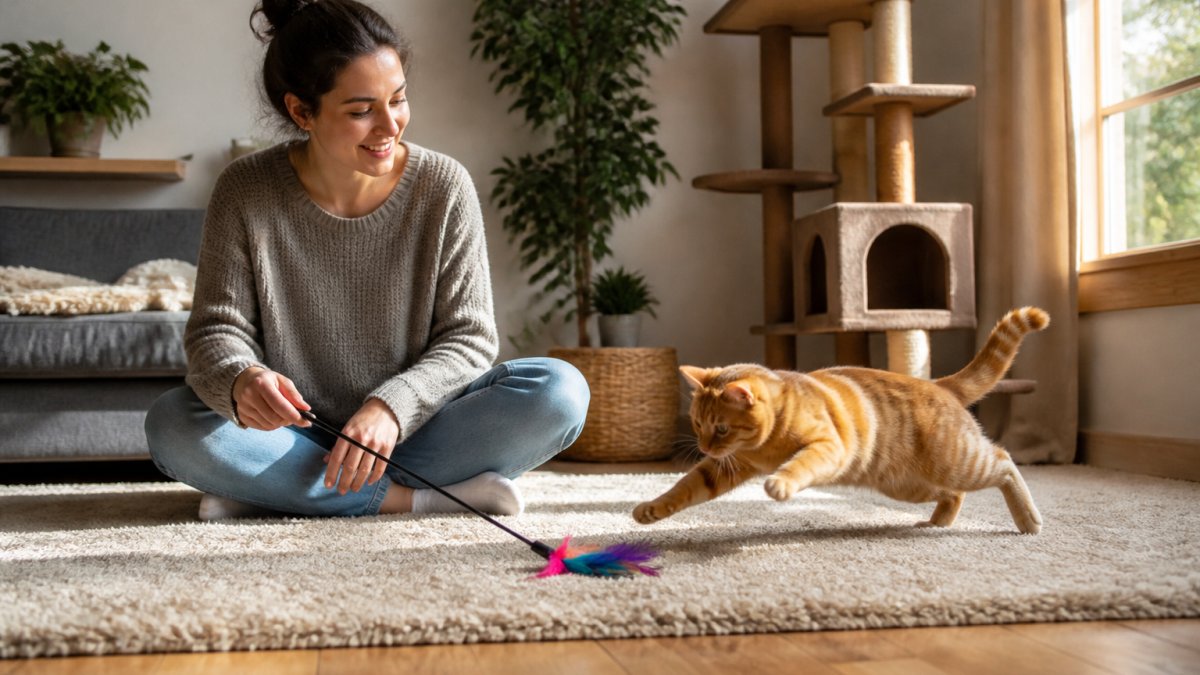
A sample week
| Day | Morning | Midday (independent) | Evening | Before bed |
|---|---|---|---|---|
| Mon | Wand, 5-10 min | Motion toy or puzzle feeder | Wand, 10-15 min | Laser or ball, 5 min |
| Tue | Wand, 5-10 min | Rotate in a different independent toy | Wand, 10-15 min | Laser or ball, 5 min |
| Wed | Wand, 5-10 min | Puzzle feeder | Wand, 10-15 min | Rest day for wand; ball only |
| Thu | Wand, 5-10 min | Motion toy | Wand, 10-15 min | Laser or ball, 5 min |
| Fri | Wand, 5-10 min | Puzzle feeder | Wand, 10-15 min | Laser or ball, 5 min |
| Sat | Wand, 10 min | Free choice of rotated toys | Wand, 15 min | Laser or ball, 5 min |
| Sun | Wand, 10 min | Free choice | Wand, 15 min | Rest |
That is roughly 30-45 minutes of active play on weekdays and 45-60 on weekends for a typical adult cat. The pattern matters more than the number: short, frequent, and finished with a catch.
How to adjust for age and fitness
- Kittens (under 1 year): Shorter sessions, more often, 5 minutes, four or five times a day. Kittens tire suddenly; stop at panting or lying down mid-pounce.
- Young adults (1-7 years): The full schedule above, the group that benefits most from a wand session ending in a sprint.
- Mature adults (7-10 years): Keep the frequency, shorten the evening session to 8-10 minutes, and add a floor-based rolling toy if jumping down has become hesitant.
- Seniors (10+ years): Two or three gentle 5-minute sessions, with floor-level toys, slow-dragging lures, and puzzle feeders over high jumps. A senior cat that stops playing entirely warrants a vet visit, pain and arthritis often show up as play refusal first.
How to adjust for temperament and mobility
- Shy or easily overstimulated cats: Play in one closed room, keep the wand low, and end before the tail twitches hard. Two 5-minute sessions beat one 15-minute session.
- Low-energy cats: Start with food-dispensing puzzle toys, which turn eating into movement. Add wand play once the cat reliably engages with the puzzle.
- Mobility-limited cats: Skip the cat wheel and high perches. A rolling ball on carpet, a floor-level teaser, and a shallow puzzle feeder cover most safe exercise for a cat with arthritis.
- High-energy cats: Add a third wand session, introduce a cat wheel if you have floor space, and rotate independent toys more aggressively.
Signs you are doing it right
A good session ends with the cat catching the toy, breathing a little faster, and losing interest on its own. The International Cat Care guidance on feline play notes that play should always end on a successful catch, never on frustration.
If your cat is overweight, suddenly reluctant to move, or panting during short play, that is a veterinary conversation, not a toy problem. Play supports a healthy weight; it does not replace veterinary guidance on diet and body condition.
Toy Safety, Durability, and Supervision
Safety separates a good toy from a dangerous one, and it usually comes down to small parts and how the toy is used. The useful rule is not "is this toy safe?" but "is this toy safe for this kind of play?" A feather wand is fine in your hand and dangerous in an empty room.
Supervised-only vs. independent-play toys
| Toy type | Supervised only | Safe for independent play |
|---|---|---|
| Wand, teaser, feather, string lures | Yes, always | No |
| Laser pointers | Yes | No |
| Balls, rolling toys, toy mice (no string) | No | Yes |
| Motion-activated and battery toys | No | Yes, if battery compartment is screwed shut |
| Puzzle and food-dispensing toys | No | Yes |
| Cat wheels and cat trees | No | Yes, once assembled and stable |
Anything on a string, ribbon, or elastic is supervised-only, including the wand you leave dangling from a doorknob "just for a minute." Cats swallow thread, and linear foreign bodies are among the most common surgical emergencies in feline practice.
The failure modes to check for
- Strings and cords: Fraying at the attachment point is the first sign. If a thread pulls loose under light tension, retire the toy.
- Bells and small attachments: Tug each one before every session. A bell that spins freely is one bite from coming off.
- Glued-on eyes and noses: The most common choke hazard on plush toys. If a piece moves when pressed, it is not secure enough for a cat.
- Battery compartments: Check the compartment is screwed shut, not snapped. A cat that licks or chews a leaking battery needs immediate veterinary attention.
- Cracked plastic: Soft plastic cracks at the seam and exposes sharp edges. Replace rather than sand down.
- Feathers: Cheap feathers shed and get swallowed. Look for feathers stitched or glued into a reinforced base, not just tucked in.
A maintenance cadence that actually works
- Before every wand session: Tug the lure, check the string and bell.
- Weekly: Inspect every independent toy for loose parts, cracks, and battery security.
- Monthly: Wash plush and fabric toys per the manufacturer's instructions; wipe hard plastic with a damp cloth. Discard anything frayed, cracked, or loose.
- Seasonally: Rotate the toy box and retire anything your cat has stopped engaging with, worn toys fail first.
Materials that hold up
Sisal and jute hold up to claws and teeth far better than thin fabric; stitched seams outlast glued ones; reinforced strings outlast elastic. None of that makes a toy indestructible, but it changes how often you replace it, and a toy you replace less often is one you inspect less often, which is its own risk. The safest toy is the one you actually check.
Conclusion: Picking the Right Toy for Your Cat
Matching toys to your cat matters more than buying the biggest haul. A shy stalker may ignore a feather wand but love a rolling ball. A bold climber may snub every floor toy and live on a tall cat tree.
That's where a curated selection helps.
Start with one wand toy, one independent toy, and one climbing structure. Rotate them, watch what your cat returns to, and build from there. Browse the Wag the Tail collection to find pieces that fit your cat's energy and your space.
Frequently Asked Questions
What is the best enrichment for cats?
The best enrichment combines interactive play, independent toys, and vertical space. Wand toys and teaser toys let cats stalk and pounce, which mimics hunting. Puzzle toys and motion-activated toys provide mental stimulation when you are busy. Cat trees and climbing structures add vertical territory. Rotating toys every few days keeps novelty high and prevents boredom, so your cat stays engaged with what you already own.
Do cat exercise wheels actually work?
Cat exercise wheels give cats a way to run at their own pace, which suits high-energy cats and breeds that need more movement than wand play alone provides. They work best when introduced gradually with treats and praise. Not every cat takes to a wheel, so treat it as an optional addition rather than a replacement for interactive play. Wheels take up floor space, so measure your room before buying.
How long should I play with my cat each day?
Two to three play sessions of 10 to 15 minutes each day covers most indoor cats. Kittens and high-energy breeds may want more, while older or less mobile cats often do better with shorter, gentler sessions. End each session with a treat or a meal to mimic the hunt-eat-groom-sleep cycle. Consistent timing matters more than long sessions, so pick slots you can keep daily.
Are interactive toys safe to leave out for cats?
Wand toys, teaser toys, and string-based toys should be put away after supervised play because cats can chew through cords or get tangled. Battery-operated and motion-activated toys are generally safer to leave out, but check for small parts that could loosen. Inspect every toy for cracks, loose bells, or exposed batteries before each use, and replace anything damaged right away.
How do I choose durable toys for a kitten or older cat?
Match the toy to your cat's mobility and temperament. Kittens need lightweight toys they can bat and chase, plus sturdy scratching posts as they grow. Older cats often prefer slow-moving toys, low perches, and soft plush textures that are easy on joints. Look for reinforced stitching, natural sisal, and solid wood or engineered wood frames, since these hold up better than thin plastic or glued joints.